
10 Best Pour Over Coffee Maker - Reviews With FAQs
Abiodun Ayomide Apr 10, 2026 8:28 PM
Finding the best pour over coffee maker can significantly influence flavor clarity, brewing control, and overall consistency. With so many drippers, materials, and filter styles available, choosing the right option requires careful comparison. That’s where this review comes in.
Here’s the key point: not all pour over brewers perform the same under real-world conditions. Factors such as heat retention, flow rate, and ease of use can directly affect extraction quality. In the sections that follow, you’ll find a detailed evaluation designed to help you make a well-informed decision.
Top Picks
The selections below represent the best pour over coffee maker options based on brewing consistency, build quality, and overall usability. Each choice was evaluated for long-term value and practical performance in everyday settings. The following list highlights models that deliver reliable results across a range of preferences and budgets.

Source: Amazon
Best Timeless Design: Chemex Pour-Over Glass Coffeemaker - Classic Series
Pros
-
Borosilicate glass construction
-
Non-porous surface
-
Dishwasher-safe build
-
Refrigeration-friendly design
Cons
-
Filters sold separately
The Chemex coffeemaker combines a simple pour-over system with high-quality borosilicate glass that resists absorbing odors or residues, supporting clean and consistent flavor. Its covered design allows brewed coffee to be refrigerated and reheated without significant flavor loss, offering practical flexibility for daily use.
Users frequently praise its elegant appearance and clarity of taste, noting that the thick filters help produce a smooth, sediment-free cup. Some, however, mention the ongoing need to purchase proprietary filters and the fragility typical of glass construction.
This model is best suited for home brewers who value refined design, clean flavor profiles, and a straightforward manual brewing process.
Best Complete Starter Set: Melitta 52 oz. Pour-Over Coffee Brewer with Glass Carafe
Pros
-
All-in-one brewing kit
-
Large 52-ounce capacity
-
Overfill-monitoring design
-
Included starter filters
Cons
-
Manual operation only
This Melitta pour-over set pairs a 52-ounce glass carafe with a brewing cone and lid, offering a straightforward, hands-on method for preparing up to 10 cups at a time. The open design helps users monitor water flow and saturation, supporting controlled extraction while keeping the process simple and accessible.
Users often appreciate the convenience of the included starter filters and the ability to brew a full pot without complex equipment. Some note that achieving consistent results requires attention to pouring technique and water temperature, as the process is entirely manual.
This model is best suited for home brewers who want a practical, large-capacity pour-over system with minimal setup and full control over extraction.
Best Reusable Filter: COSORI Pour Over Coffee Maker with Double Layer Stainless Steel
Pros
-
Dual-layer stainless steel filter
-
Heat-resistant borosilicate glass
-
34-ounce serving capacity
-
Dishwasher-safe components
Cons
-
Hand-wash wooden sleeve
The COSORI pour-over coffee maker combines a dual-layer 304 stainless steel filter with a borosilicate glass decanter, allowing fine coffee oils to pass through while minimizing sediment. Its heat-resistant construction and 34-ounce capacity make it practical for small gatherings, while offering users full control over brewing variables such as water flow and temperature.
Users frequently highlight the fuller body produced by the metal filter and appreciate the absence of disposable paper filters. Some note that achieving a clean cup may require careful pouring technique and thorough rinsing of the filter after use.
This model is best suited for coffee drinkers who prefer a reusable filter system and greater control over flavor customization.
Best Low-Effort Brewing: OXO Brew Single Serve Pour-Over Coffee Maker
Pros
-
Auto-drip water tank
-
Integrated measurement markings
-
Heat-retaining lid
-
Included starter filters
Cons
-
Limited 12-ounce capacity
The OXO pour-over coffee maker uses an auto-drip tank to regulate water flow, helping deliver consistent extraction with less manual precision required from the user. Measurement markings and a heat-retaining lid further simplify the process, making it easier to produce a balanced 12-ounce brew with minimal setup.
Users often appreciate its straightforward operation and repeatable results, particularly for single servings. Some note that the smaller capacity may not suit households needing multiple cups at once.
This model is best suited for individuals seeking a compact, user-friendly pour-over system that reduces the need for precise pouring technique.
Best Budget Reusable: Bodum 34oz Pour Over Coffee Maker, High-Heat Borosilicate Glass
Pros
-
Permanent stainless steel filter
-
Heat-resistant borosilicate glass
-
Cork band grip
-
Eight 4-ounce cup capacity
Cons
-
Single-wall insulation
The Bodum pour-over coffee maker features a permanent stainless steel mesh filter designed to allow aromatic oils to pass through, contributing to a fuller-bodied cup. Its borosilicate glass carafe with cork band offers heat resistance and a secure grip, while the straightforward manual process supports quick preparation.
Users often value the reusable filter and balanced flavor profile, noting that it reduces ongoing paper filter costs. Some mention that the single-wall glass can lose heat relatively quickly compared to insulated alternatives.
This model is best suited for cost-conscious coffee drinkers who want a simple, reusable pour-over system with classic styling.

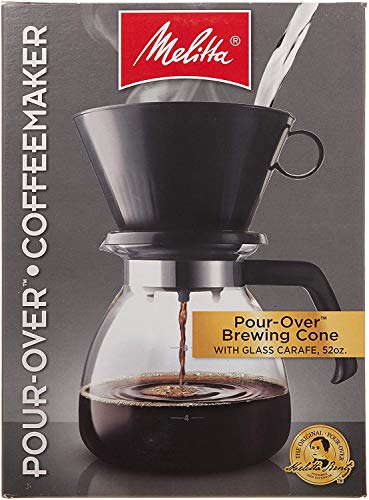


- 9.3
- BrandOXO

- 9.2
- BrandBodum
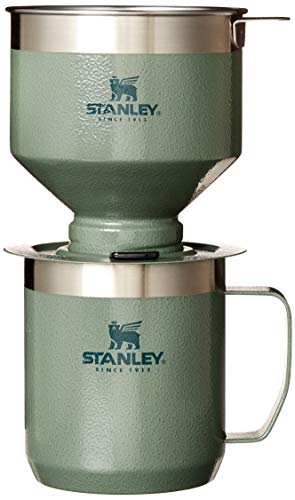
- 8.9
- BrandSTANLEY
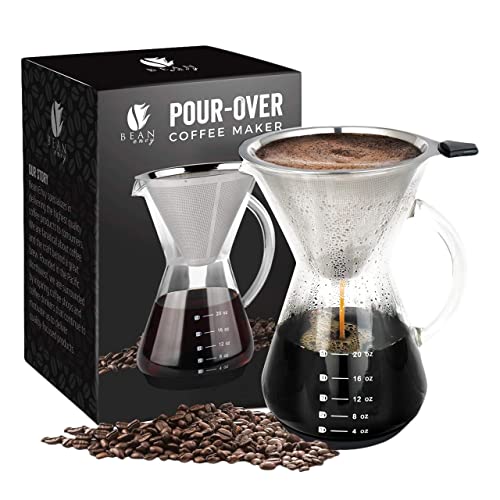
- 8.7
- BrandBean Envy

- 8.5
- BrandKalita

- 8.3
- BrandLHS
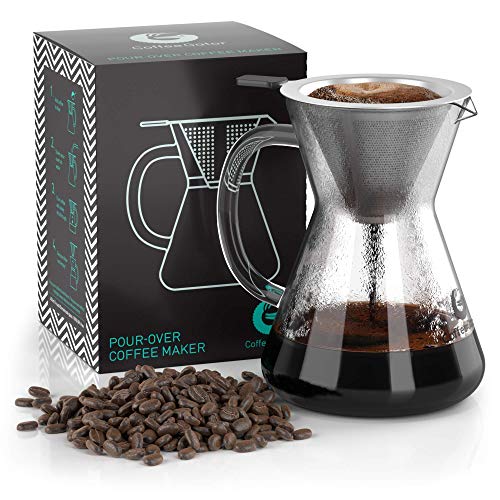
- 8.2
- BrandCoffee Gator
Last update on 2026-04-10 / Affiliate links / Images, Product Titles, and Product Highlights from Amazon Product Advertising API
A pour over coffee maker uses gravity and manual water flow to extract flavor from ground coffee. Hot water is poured slowly over coffee grounds held in a filter, allowing the water to pass through the grounds and drip into a carafe or cup below. The rate of pouring, grind size, and water temperature all influence extraction. Because the process is manual, the user directly controls saturation and brew time. This level of control can result in a clean, well-defined flavor profile when executed properly.
How long should a pour over coffee take?
A standard pour over brew typically takes between three and four minutes from the first pour to the final drip. The initial bloom phase, where a small amount of water saturates the grounds, usually lasts about 30 to 45 seconds. After blooming, the remaining water is added in controlled pours to maintain consistent extraction. If the brew finishes too quickly, the grind may be too coarse; if it drags on much longer than four minutes, the grind may be too fine. Total time should remain relatively consistent for balanced results.
What is the best pour over coffee method?
There is no single best method, but most effective approaches follow a structured sequence. Start with freshly ground coffee at a medium to medium-fine consistency and use water heated to approximately 195 to 205 degrees Fahrenheit. Begin with a bloom pour to release trapped gases, then continue pouring in slow, circular motions to ensure even saturation. Maintaining a steady flow rate helps prevent channeling, where water passes unevenly through the grounds. Consistency in measurements and technique generally produces the most reliable cup.
What is required for pour over coffee?
At a minimum, pour over brewing requires a dripper, a filter, freshly ground coffee, hot water, and a vessel to collect the brewed coffee. Many users also rely on a gooseneck kettle for greater pouring precision and a scale to measure coffee and water accurately. A burr grinder is recommended for consistent grind size, which supports even extraction. While the equipment is relatively simple, attention to detail plays a significant role in the outcome. Clean tools and quality water further contribute to clarity and flavor balance.
What is the disadvantage of pour-over coffee?
The primary disadvantage of pour-over coffee is the level of attention and precision required during brewing. Unlike automated drip machines, the user must actively manage water flow, timing, and technique. Small inconsistencies in pouring or grind size can noticeably affect flavor. Additionally, the manual process may not be ideal for preparing multiple servings quickly. For some households, the time and effort involved may outweigh the benefits of control.
What is the 80 20 rule for coffee?
The 80 20 rule in coffee generally refers to the idea that a small number of variables have the greatest impact on flavor. In pour-over brewing, grind size, coffee-to-water ratio, and water temperature often account for most of the difference in cup quality. Focusing on dialing in these core elements tends to produce significant improvements without overcomplicating the process. Minor adjustments to pouring technique or equipment can refine results, but they typically play a secondary role. Prioritizing the fundamentals helps create consistent and repeatable outcomes.
Related Posts:
10 Best K Cup Coffee Maker in 2026 Review & Buyer's Guide
Top 10 Best Coffee Maker With Grinder in 2026: Reviews
10 Best Coffee Maker Grinder Combination We've Tested: Top Rated
Choosing the best pour over coffee maker ultimately depends on your preferred balance of control, convenience, and capacity. The models reviewed here vary in materials, filter types, and design features, but each offers a reliable approach to manual brewing. By considering factors such as ease of use, maintenance, and flavor clarity, you can identify the option that aligns with your routine and expectations. A thoughtful comparison ensures you select a brewer that delivers consistent results over time.

Abiodun Ayomide
Abiodun Ayomide is a master in economics, she has many years of experience in a Marketing position, She always has in-depth assessments on every aspect of products that customers care about. In her free time, she often listens to music and sips tea.







- How to Clean Your Air Conditioner So It Runs Like New All Summer
- Sainlogic SA7 Review: The Best WIFI Smart Weather Station
- Cheap Robot Vacuum and Mop Options for Efficient Home Cleaning
- How to choose a robot vacuum for pet hair
- Ultimate Guide: How to Protect Your Outdoor Security Cameras from Hacks and Vandalism
- How to Maximize Cooling Efficiency with the Best Portable Air Conditioner
- How To Maintain And Clean Your Cooling Fan For Longevity
- How to Fix Smart Switch Won't Connect to Device
- The best smart Wi-Fi router for home
- Guide to cleaning washing machines at home